How to Build a $200,000/Year Preventive Maintenance Program Without Chasing Quarterly Renewals
Compressed air preventive maintenance contract automation uses AI and IoT to manage air compressor service contracts in real time. The system reduces downtime by up to 90%, transforms maintenance from a reactive cost center into a predictable revenue engine, and eliminates the cycle of chasing quarterly renewals. This guide breaks down how to build a program generating $200,000 or more per year in automated recurring revenue from compressed air service agreements.
Contracts shift from fixed schedules to real-time sensor data, predicting compressor failures weeks before they occur
Reduces energy costs by 20-30% and extends equipment life by 40-60% through condition-based service timing
Manages the full contract cycle from proposal to renewal, cutting administrative work by 70-80%
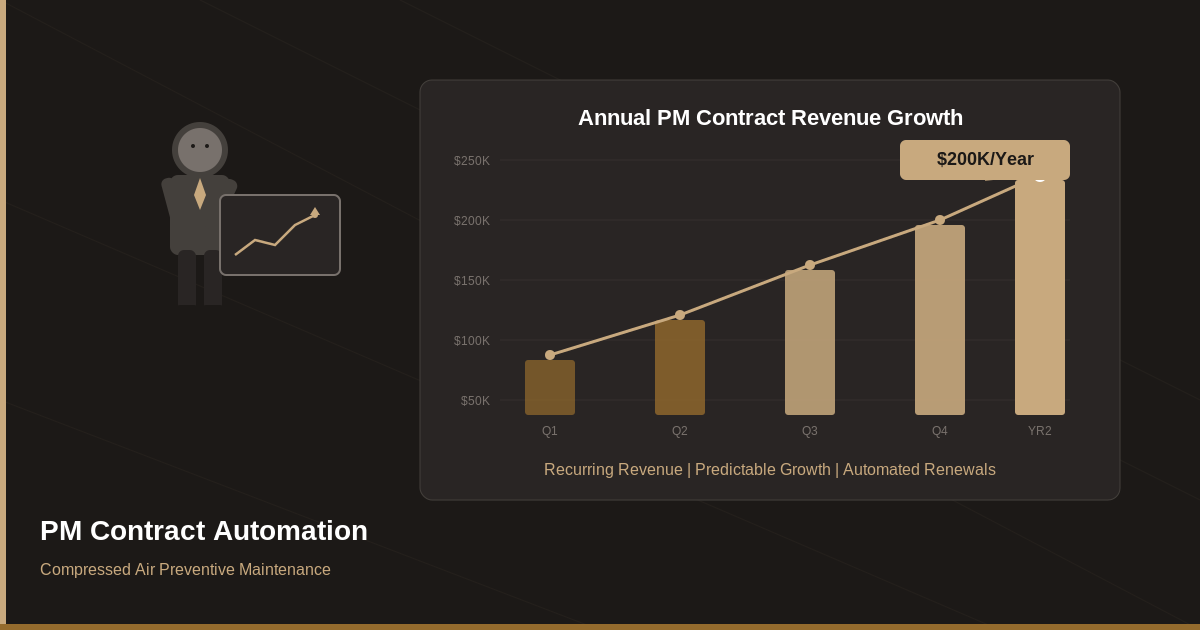
Foundation of Automated Preventive Maintenance Contracts
Compressed air preventive maintenance contract automation combines AI analytics with IoT monitoring hardware to manage service agreements dynamically. This approach reduces unplanned downtime by up to 90% across industrial compressed air installations. Rather than relying on calendar-based visits that miss developing problems, the system responds to the actual operating condition of each compressor in the fleet.
The digitized service agreement process replaces manual spreadsheets and calendar reminders with continuous equipment health tracking. Sensors installed on compressors feed operational data to a cloud platform where AI models learn normal operating patterns for each machine. When deviations occur, the system triggers maintenance actions automatically, turning a simple service promise into a data-driven performance partnership. This approach mirrors how compressed air repair AI estimating tools automate complex calculations based on real-time system data.
Compressed air preventive maintenance contract automation replaces manual scheduling with IoT sensors and AI analytics that monitor compressor health in real time. Service companies using this approach achieve 90% downtime reduction, 20-30% energy cost savings, and 40-60% equipment life extension through full contract lifecycle automation. A program serving 20 clients on automated maintenance contracts generates $200,000 or more per year in predictable recurring revenue without chasing quarterly renewals.
Essential Insights for Facility Managers
Automated compressed air maintenance contracts deliver measurable operational gains for facility managers. Energy costs drop by 20-30% as the system identifies inefficiencies like air leaks and suboptimal pressure regulation that waste output. Equipment lifespan extends by 40-60% because components receive service based on actual wear rather than arbitrary schedules.
The fundamental shift from preventive to predictive maintenance changes the value proposition for both the service provider and the customer. IoT sensors enable real-time monitoring of pressure, temperature, vibration, and oil quality across every compressor under contract. Remote diagnostics catch developing issues before they cause production stoppages. Automated AMC packages eliminate the manual workload of tracking contract terms, scheduling technician visits, and managing renewal timelines.
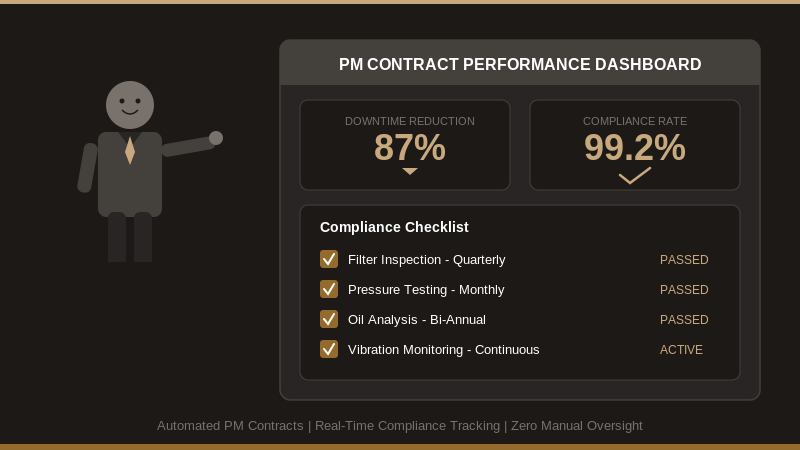
Mechanics of Compressed Air Contract Automation
The system digitizes service contracts using cloud-based platforms and IoT sensor networks installed on each compressor. Contract terms adjust dynamically as real-time data reveals changing equipment conditions. If sensors detect elevated contamination levels, the system schedules an additional oil change without manual intervention. If vibration patterns indicate bearing wear, a technician dispatch is triggered weeks before failure would occur.
Administrative tasks that previously consumed hours of staff time are fully automated within the contract lifecycle. The system generates proposals based on equipment specifications and usage history, manages digital signatures for contract execution, schedules technicians based on geographic routing and urgency, and issues invoices tied to completed service events. These workflows integrate with tools like an AI voice agent that captures inbound service requests and triggers dispatch sequences instantly.
Core Components Driving Automated Maintenance Systems
Modern compressed air preventive maintenance contract automation systems integrate four core technology layers. Each component handles a specific function in the maintenance pipeline, and together they automate decisions that previously required manual oversight and can improve uptime by 90%.
Analyzes equipment specifications, usage history, and failure risk to generate tailored contract proposals automatically
Sensors track critical parameters including pressure, vibration, temperature, air quality, and energy consumption
Manages agreements from digital signing through renewal with audit-ready compliance documentation
Real-time view of system health, service history, and financial performance for providers and customers
The Shift from Preventive to Predictive Maintenance
Predictive maintenance uses real-time performance data and vibration analysis to cut maintenance costs by 30% compared to traditional calendar-based preventive programs. The distinction is operational, not semantic. Preventive maintenance services equipment on a fixed schedule regardless of condition. Predictive maintenance services equipment when sensor data indicates actual need, eliminating unnecessary visits while catching problems that fixed schedules miss.
For compressed air systems, predictive maintenance reduces unplanned downtime by up to 90% through continuous monitoring of compressor health indicators. The transition from preventive to predictive models is what makes compressed air preventive maintenance contract automation financially viable at scale. Service companies stop wasting technician hours on healthy machines and focus resources where data shows they are needed.
Quarterly or monthly visits regardless of equipment condition
Service dispatched when real-time sensor data detects anomalies or degradation trends
Unnecessary visits increase labor costs while missed issues between visits cause expensive failures
Service only when needed reduces labor waste and prevents costly unplanned breakdowns
Breakdowns still occur between scheduled visits with no early warning system
Continuous monitoring predicts failures weeks in advance, allowing proactive intervention
Checklists, calendar reminders, and technician experience drive service decisions
Machine learning analytics and sensor networks with automated alerting and dispatch
How IoT and AI Drive Efficiency in Maintenance Contracts
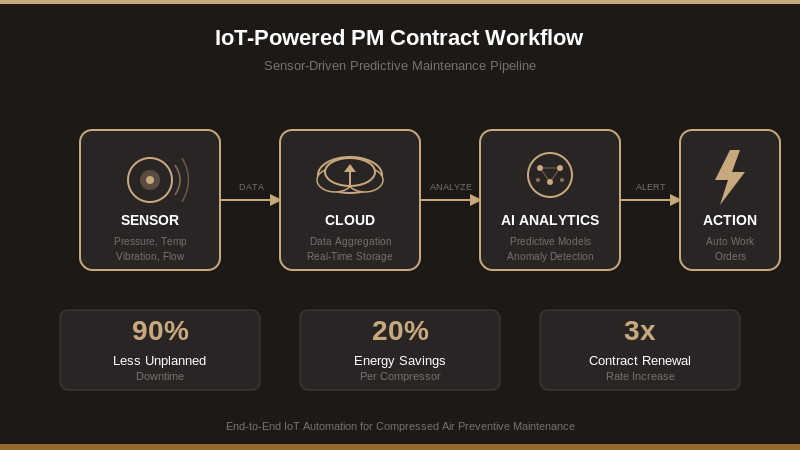
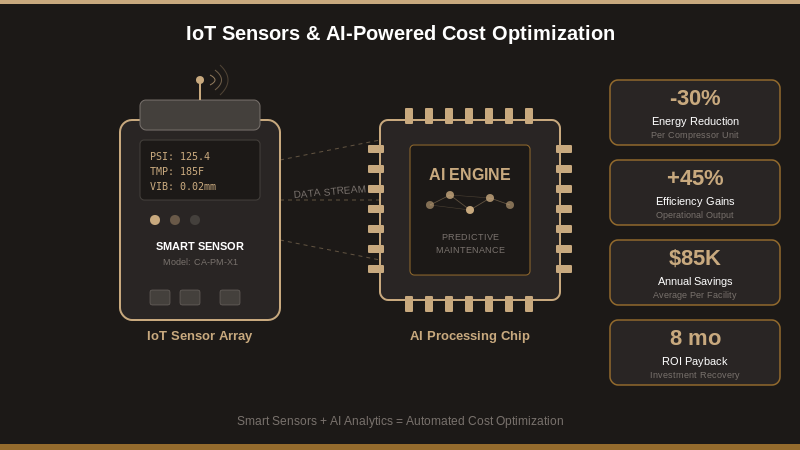
IoT devices installed on compressed air equipment collect real-time data on system pressure, energy consumption, vibration patterns, and air quality. This data streams to cloud platforms where AI models analyze trends and detect anomalies that indicate developing failures. The system reduces energy costs by approximately 20% by identifying inefficiencies such as air leaks, poor pressure regulation, and suboptimal compressor cycling.
The technology stack operates in layers. Edge sensors capture granular operational data from each compressor. Cloud computing handles remote monitoring, data storage, and processing at scale. AI analysis correlates patterns across the fleet to predict failures weeks before they occur. Optional digital twins create virtual replicas of physical compressor systems for advanced simulation and scenario testing. Each layer builds on the previous one to form a fully automated compressed air preventive maintenance contract automation pipeline.
Structuring AMC Packages for Scalable Revenue
Annual maintenance contract packages structured in tiers create scalable revenue while matching service levels to customer needs and budgets. Tiered AMC packages reduce overall maintenance costs by 20-40% for customers compared to ad-hoc service calls. For service providers, the tiered model increases contract value per customer by offering clear upgrade paths from basic monitoring to full predictive coverage.
Routine inspections, performance reporting, and basic IoT monitoring with quarterly reviews
Full consumables coverage including filters, oil changes, wear components, and predictive alerts
Complete coverage including major repairs, emergency response, and full predictive maintenance automation
Implementation Workflow for Maintenance Contract Automation
Compressed air preventive maintenance contract automation follows a four-phase lifecycle from initial system assessment through continuous optimization. Service companies that follow this workflow typically achieve positive ROI within six months of deployment. The implementation process is designed to minimize disruption to existing operations while building the data foundation for predictive capabilities.
Assess existing equipment condition, install sensors, and collect baseline operational data for AI model training
Generate customized contract terms based on equipment analysis, risk profiles, and customer requirements
Activate condition-based service triggers, automated dispatch, and real-time monitoring dashboards
Refine AI predictions, adjust contract terms based on performance data, and expand coverage across the fleet
Challenges in Contract Automation Adoption
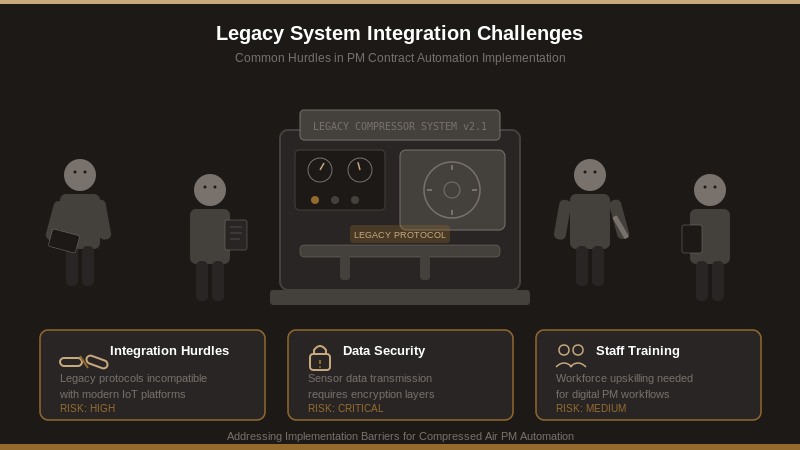
Legacy system integration and data security concerns affect 20-30% of compressed air preventive maintenance contract automation deployments. Older compressors may lack sensor-ready interfaces, requiring retrofit solutions or gateway devices to connect to IoT networks. Data security demands encrypted transmission and storage protocols to protect sensitive operational and financial information flowing through the platform.
Over-reliance on automation without human oversight creates risk in edge cases where AI models encounter conditions outside their training data. Skill gaps in facility maintenance teams require investment in training programs that build competency with new monitoring platforms. Service companies that address integration planning and customer education early in the deployment process see faster adoption rates, higher contract retention, and fewer support escalations. Compliance documentation automation, similar to what hood cleaning contractors use for regulatory tracking, helps maintain audit-ready records throughout the contract lifecycle.
Automation's Role in Industry 4.0 and Smart Facilities
Compressed air preventive maintenance contract automation aligns directly with Industry 4.0 principles by integrating cloud platforms, edge computing, and AI analytics into facility operations. Smart plants that adopt connected maintenance infrastructure report 25% improvement in overall operational efficiency. As industrial facilities expand their IoT ecosystems, automated maintenance contracts transition from a competitive advantage to a baseline requirement.
The convergence of predictive maintenance, automated contract management, and real-time monitoring creates a service model that scales without proportional increases in administrative overhead. Service companies that build this infrastructure now position themselves to capture the growing market for connected compressed air management. Start building your automated preventive maintenance program with Ironback at ironback.ai.
Frequently Asked Questions
How does preventive maintenance contract automation improve compressed air system performance?
Preventive maintenance contract automation improves compressed air system performance by replacing fixed service schedules with real-time IoT sensor monitoring and AI-driven predictive analytics. The system detects anomalies in pressure, vibration, and temperature weeks before failures occur, reducing unplanned downtime by up to 90%. Energy efficiency improves by 20-30% as the platform identifies leaks, pressure regulation issues, and suboptimal compressor cycling automatically.
What is included in automated air compressor maintenance contracts?
Automated air compressor maintenance contracts typically include IoT sensor installation for real-time equipment monitoring, AI-powered predictive analytics, automated technician scheduling and dispatch, and digital contract lifecycle management. Tiered packages range from basic Service Plans with routine inspections to Total Responsibility Plans covering major repairs, emergency response, and full predictive maintenance automation.
How does predictive maintenance work in compressed air systems?
Predictive maintenance in compressed air systems works by installing IoT sensors that continuously monitor operating parameters such as pressure, vibration, temperature, and oil quality. AI algorithms analyze this sensor data against learned normal operating patterns to detect early signs of component degradation. When anomalies are identified, the system automatically triggers maintenance actions or technician dispatch before equipment failure occurs.
Can automation reduce maintenance costs and improve energy efficiency?
Automation reduces compressed air maintenance costs by 20-40% through condition-based servicing that eliminates unnecessary scheduled visits while preventing costly unplanned breakdowns. Energy efficiency improves by 20-30% as IoT sensors identify air leaks, pressure regulation inefficiencies, and suboptimal cycling patterns. Equipment lifespan extends by 40-60% because components receive service based on actual wear data rather than arbitrary time intervals.
What technologies are used in compressed air maintenance contract automation?
Compressed air maintenance contract automation uses IoT sensors for real-time data collection, cloud computing platforms for data storage and processing, and AI machine learning models for predictive failure analysis. Supporting technologies include digital twins for simulation, automated proposal and invoicing software, GPS-based technician dispatch systems, and dashboard platforms that give both service providers and facility managers unified visibility into system health and contract status.
Related
Find your first automation
Use the free Operations Scorecard. Two questions give you one workflow to investigate and a measure to check before building.