AI Voice Agent for Steam Boiler Contractors: Triage 40 Emergency Calls Without Missing One Job
Why Steam Boiler Contractors Need an AI Voice Agent
An AI voice agent for steam boiler contractors answers every inbound call, asks diagnostic questions, and books jobs automatically without requiring a live dispatcher. These systems handle 70-80% of routine interactions end-to-end, from pressure drop reports to annual maintenance scheduling, ensuring no revenue-generating call ever hits voicemail.
Steam boiler emergencies do not follow business hours. When a building manager calls at 2 AM reporting ignition failure or a pressure relief valve discharge, the AI voice agent captures critical details, assesses urgency, and either dispatches an on-call technician or schedules a next-day appointment based on severity. The result is fewer missed jobs, faster response times, and a dispatcher team that focuses exclusively on complex escalations.
AI answers every call around the clock, capturing leads and triaging emergencies that would otherwise go to voicemail
Connects with dispatching and FSM platforms to book appointments based on live technician availability
Handles basic troubleshooting and call routing, escalating only complex cases that require human judgment
Introduction to AI Voice Agents in the Boiler Industry
AI voice agents represent a fundamental shift in how steam boiler contractors manage customer communication. Instead of relying on answering services or dispatcher teams to handle every inbound call, these systems automate call handling from greeting through resolution, converting missed calls into booked service appointments. For contractors running lean operations, this means capturing revenue that previously disappeared into voicemail boxes.
The technology resolves 70-80% of standard interactions without human involvement. Callers reporting routine maintenance needs, requesting quotes, or describing common boiler symptoms receive immediate assistance, appointment confirmations, and follow-up SMS messages. The remaining 20-30% of calls that involve complex diagnostics, safety-critical emergencies, or high-value commercial accounts route seamlessly to human dispatchers with full context already captured.
How AI Voice Agents Work: A Technical Overview
The AI voice agent converts speech to text in real time, applies natural language understanding to identify caller intent, and generates contextually appropriate responses. Behind the scenes, it connects to the contractor's CRM, pulling customer history and equipment records to personalize each interaction. A property manager calling about a recurring low-pressure alarm on their Cleaver-Brooks unit gets acknowledged by name with full service history context.
These systems manage the full range of caller interactions including new customer inquiries, existing customer service requests, emergency reports, billing questions, and appointment rescheduling. The voice agent maintains conversation state across interruptions, handles multi-turn dialogues, and adapts its questioning strategy based on the urgency signals it detects in caller responses.
Core Capabilities for Steam Boiler Service Operations
The AI voice agent delivers four primary capabilities that directly impact steam boiler contractor revenue: automated call handling, lead qualification, appointment booking, and emergency triage. Speech recognition accuracy reaches 95% even with technical boiler terminology, handling terms like economizer, deaerator, blowdown, and feedwater without confusion. This precision ensures that diagnostic information captured during calls translates accurately into work orders.
Handles technical boiler terminology including pressure ratings, equipment models, and fault codes
Manages greeting, qualification, diagnostics, booking, and confirmation without human intervention
Identifies safety-critical situations like gas leaks, pressure vessel failures, and carbon monoxide concerns for immediate dispatch
Captures property type, equipment details, service history, and budget indicators before routing to sales
Transforming Customer Support Response Times
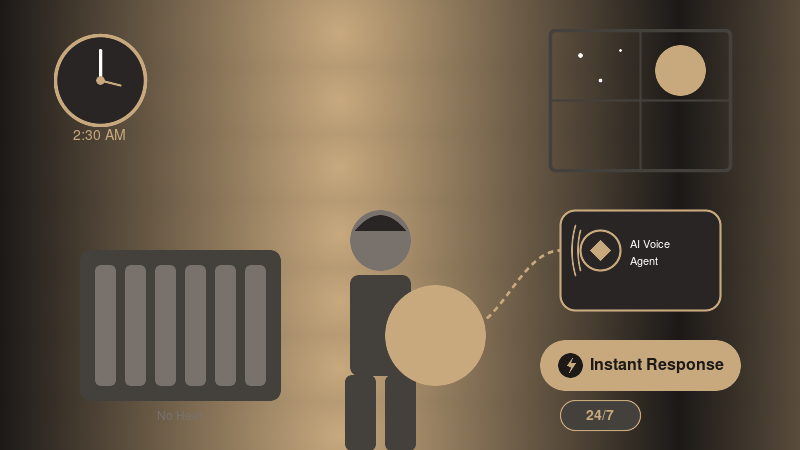
Traditional steam boiler contractor operations suffer from response time delays of 2+ hours during peak call periods, after hours, and weekends. The AI voice agent eliminates this bottleneck entirely by providing instant pickup on every call regardless of volume or time of day. Callers experiencing a boiler lockout in a 200-unit apartment building at 6 AM on a Saturday get the same immediate response as a Monday morning maintenance request.
The system handles both inbound and outbound communications. Beyond answering incoming calls, it proactively contacts customers for appointment confirmations, maintenance reminders, and follow-up satisfaction checks. Multilingual support extends coverage to diverse service areas, with the agent switching between English, Spanish, and other languages based on caller preference without requiring separate phone lines or bilingual staff.
Integration with Field Service Management and Scheduling
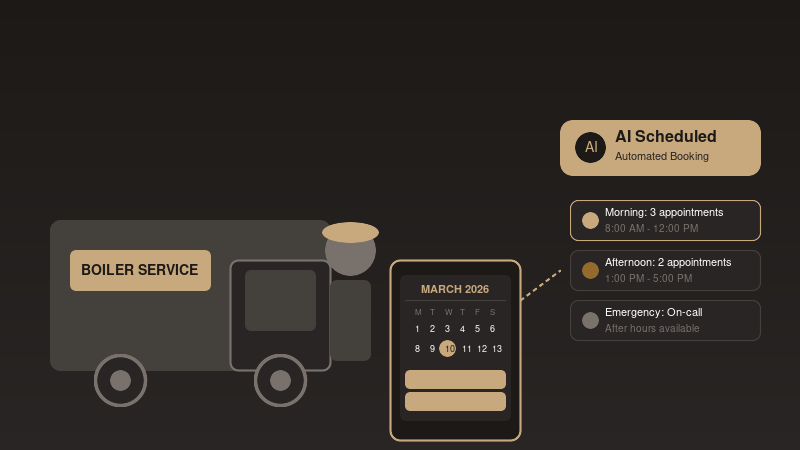
The AI voice agent connects directly to field service management platforms like ServiceTitan, Housecall Pro, and Jobber, accessing real-time technician availability to book appointments during the call itself. This integration reduces scheduling errors by 30% compared to manual dispatcher booking because the system cannot double-book, ignores technician skill mismatches, or overlook travel time between jobs. Every appointment lands on the correct calendar with the right technician assigned.
Automated dispatch triggers fire immediately after booking. The assigned technician receives job details, customer history, and equipment specifications via push notification. Simultaneously, the customer receives an SMS confirmation with the appointment window, technician name, and a link to track arrival. This end-to-end automation eliminates the manual handoff steps where information traditionally gets lost or delayed.
Steam boiler contractors using AI voice agents capture 100% of inbound calls and convert them into qualified leads or booked appointments. The system triages emergencies instantly, books routine maintenance during the call, and reduces scheduling errors by 30% through direct FSM integration. For contractors handling 40+ daily calls, this translates to recovering thousands in monthly revenue that previously went to competitors when calls hit voicemail.
AI-Powered Diagnosis and Troubleshooting on First Call
The AI voice agent resolves 60-70% of simple boiler problems during the initial call by guiding customers through structured troubleshooting sequences. A caller reporting no heat receives step-by-step instructions to check the thermostat setting, verify the emergency switch position, and inspect the pressure gauge reading. Problems that resolve through these guided steps save a truck roll entirely, improving customer satisfaction while preserving technician capacity for jobs that genuinely require on-site expertise.
For issues that cannot be resolved remotely, the agent assesses urgency using a decision tree calibrated to steam boiler failure modes. It distinguishes between a minor circulator pump noise that can wait until Monday and a low-water cutoff alarm that requires same-day response. Complete interaction histories log to the CRM automatically, giving the dispatched technician full context on what was already attempted before they arrive on site.
Impact on Lead Generation and Revenue Capture
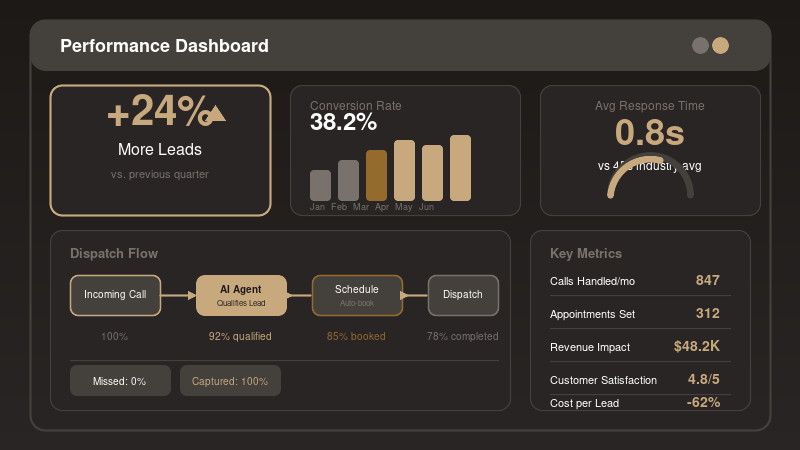
AI voice agents increase lead conversion rates by up to 24% for steam boiler contractors by eliminating the single biggest lead killer: unanswered calls. Industry data shows that 85% of callers who reach voicemail never call back. They call the next contractor on their list. The AI voice agent ensures that every caller receives immediate engagement, professional qualification, and a clear next step whether that is a booked appointment, a quote request, or an emergency dispatch.
Beyond raw conversion, the system qualifies leads automatically by capturing property type, number of boiler units, equipment age, service history, and project scope during the initial conversation. This qualification data routes to sales teams pre-scored, enabling them to prioritize high-value commercial opportunities like multi-building maintenance contracts over one-time residential repairs. The AI handles the volume while humans close the deals that matter most.
Automation of Dispatch and Workflow Management
Operational efficiency improves by 25% when dispatch and workflow management run through the AI voice agent rather than manual processes. Real-time dispatch assigns the nearest qualified technician based on GPS location, certification level, and current workload. The system manages task creation, documentation, and team coordination without requiring dispatcher intervention for standard service calls.
Automated documentation captures every customer interaction, technician assignment, and job outcome in the contractor's system of record. This eliminates the end-of-day paperwork burden that causes technicians to skip documentation, creating gaps in service histories. When a boiler fails again six months later, the complete record of previous diagnostics, parts replaced, and recommendations made exists in full detail.
Challenges and Realistic Failure Rates
Honesty about limitations matters: 80% of AI voice agent deployments struggle with complex, non-linear conversation scenarios. A panicked building superintendent describing multiple simultaneous failures across different boiler rooms challenges even well-trained systems. Speech recognition degrades in noisy environments like mechanical rooms, and latency spikes during peak usage can create awkward conversational pauses that frustrate callers expecting human-level responsiveness.
These limitations become most apparent during genuine emergencies where callers speak rapidly, interrupt frequently, and provide information out of sequence. The AI may misclassify urgency when a caller understates a serious problem or overstates a minor one. Contractors must calibrate their systems conservatively, erring toward escalation rather than autonomous resolution when safety-critical boiler systems are involved.
Hybrid Human-AI Workflows for Maximum Reliability
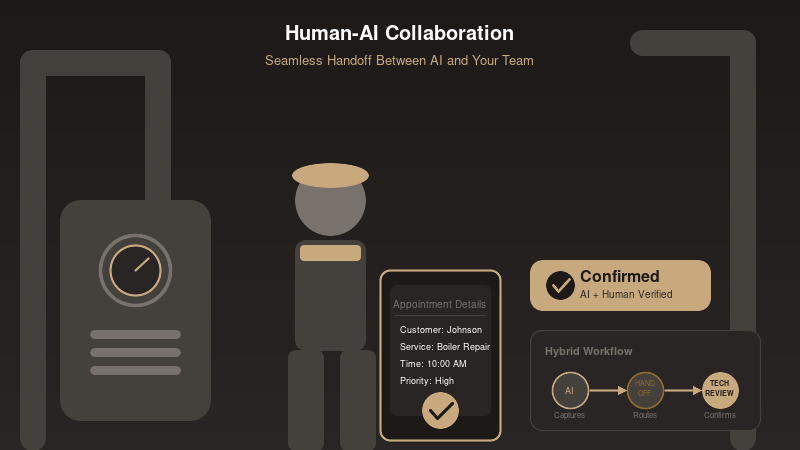
The highest-performing steam boiler contractors implement hybrid human-AI workflows that achieve significantly higher success rates than either approach alone. The AI handles volume, routine interactions, and after-hours coverage while human dispatchers manage complex emergencies, high-value accounts, and safety-critical decisions. Seamless live transfer protocols ensure that when a call escalates, the human agent receives complete conversation context, diagnostic findings, and customer history without the caller repeating information.
Human oversight remains essential for safety-critical boiler scenarios including suspected gas leaks, carbon monoxide concerns, and pressure vessel integrity questions. The AI voice agent recognizes these trigger conditions and escalates immediately rather than attempting autonomous resolution. This conservative approach protects both the contractor's liability exposure and the building occupants who depend on correct emergency response decisions being made by qualified professionals.
Frequently Asked Questions
How can an AI voice agent help steam boiler contractors manage customer calls?
An AI voice agent for steam boiler contractors answers every inbound call 24/7, asks diagnostic questions about boiler symptoms like pressure drops or ignition failures, and routes calls based on urgency. It handles 70-80% of interactions autonomously including appointment booking, quote requests, and basic troubleshooting, freeing dispatchers to focus on complex emergencies and high-value commercial accounts.
Can AI voice agents schedule boiler service appointments automatically?
Yes, AI voice agents integrate directly with field service management platforms like ServiceTitan, Housecall Pro, and Jobber to book appointments during the call based on real-time technician availability. The system checks technician certifications, travel time, and current workload to assign the right person, then sends SMS confirmations to both the customer and the assigned technician automatically.
How do AI voice assistants improve emergency boiler service response?
AI voice agents provide instant emergency triage by identifying safety-critical conditions such as gas leaks, low-water cutoff alarms, and pressure relief valve discharges within the first seconds of a call. They dispatch on-call technicians immediately for true emergencies while scheduling next-day appointments for non-critical issues, reducing average emergency response initiation time by up to 2 hours compared to traditional answering services.
What systems can AI voice agents integrate with for boiler contractors?
AI voice agents for steam boiler contractors integrate with CRM platforms, field service management software like ServiceTitan and Jobber, scheduling calendars, GPS-based dispatch systems, and project management tools. They also connect to customer databases to pull equipment histories, warranty information, and previous service records during live calls for personalized service delivery.
Can AI voice agents help generate leads and improve customer experience?
AI voice agents increase lead conversion by up to 24% by ensuring every call receives an immediate professional response instead of reaching voicemail. They qualify leads automatically by capturing property type, equipment details, and project scope during initial conversations, then route pre-scored opportunities to sales teams. Customers experience zero hold time, consistent service quality, and immediate appointment confirmations.
Related
Find your first automation
Use the free Operations Scorecard. Four questions give you one workflow recommendation and the measures that should prove it works.