Hood Cleaning Contractor Compliance Documentation AI: Clean Compliance Docs Without the Morning Paperwork
The fast-paced world of commercial kitchens depends on professional hood cleaning for fire safety and strict compliance. For contractors, documenting every job is not just paperwork. It proves work was done, supports NFPA 96 requirements, and helps satisfy fire marshal inspections.
But manual documentation can be complex and time-consuming. Hood cleaning contractor compliance documentation AI is changing this process by improving accuracy, speed, and reliability. Here is how AI simplifies compliance documentation and reduces daily workload for hood cleaning operations.
Hood cleaning contractor compliance documentation AI improves how compliance records are created and managed, making documentation faster, more accurate, and easier to handle. AI automates data extraction, report creation, and cleaning certificates, reducing manual work. Clear and structured documentation supports fire marshal inspections and insurance needs. Consistent records help maintain NFPA 96 compliance and improve overall fire safety.
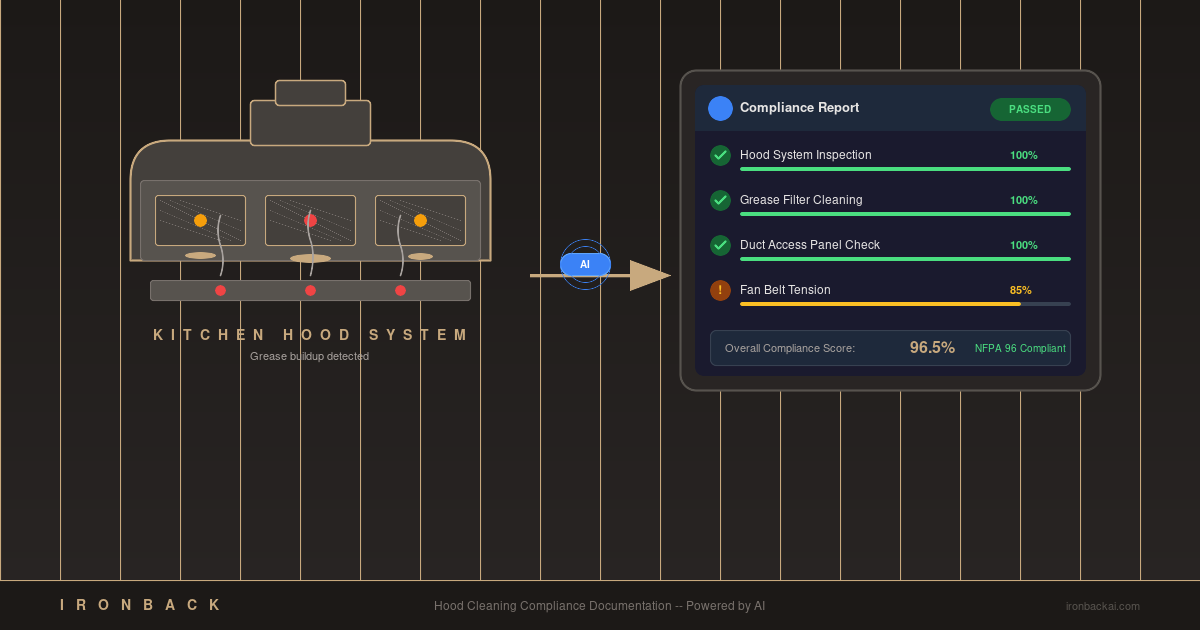
Hood cleaning contractor compliance documentation AI is software that uses artificial intelligence to automate the creation, management, and storage of NFPA 96 compliance records for hood cleaning services. It replaces manual paperwork, handwritten field forms, and scattered photo files with automated data extraction, standardized report generation, and instant cleaning certificate creation. According to research reported by Secureframe (Ponemon Institute and GlobalSCAPE), the cost of non-compliance is 2.71 times higher than maintaining compliance. Ironback.ai deploys this technology as a full-time AI operations specialist embedded inside hood cleaning contractor businesses.
What Is Hood Cleaning Contractor Compliance Documentation AI
Hood cleaning contractor compliance documentation AI is software that uses artificial intelligence to handle compliance paperwork for hood cleaning services. It helps collect, organize, and create documents automatically. This is not just digital forms. The system reads field data, understands what happened during the job, and turns it into clear, structured reports. Everything is formatted and ready for audits, inspections, and records. In short, it helps contractors manage compliance without doing everything by hand.
Why Compliance Documentation Matters for Hood Cleaning Contractors
In commercial kitchens, proper hood cleaning and clear compliance documentation are essential for fire safety and meeting standards like NFPA 96. Good safety practices include removing grease buildup from exhaust systems, keeping clear inspection records, and providing cleaning certificates that confirm the work was done correctly.
According to the Ponemon Institute and GlobalSCAPE, as reported by Secureframe, the cost of non-compliance can be up to 2.71 times higher than the cost of maintaining compliance. This highlights the financial and operational risks of incomplete or inadequate documentation for hood cleaning contractors.
The Problem with Manual Compliance Documentation
The traditional approach to compliance documentation for hood cleaning contractors is slow and often unreliable. Most of the work is done by hand, which makes errors more likely. In the field, technicians usually fill out paper forms. These forms can get covered in grease, making them hard to read later. Photos taken during the job are often inconsistent, with no clear structure or labeling.
Back at the office, data from forms must be typed again, reports need to be rewritten manually, and cleaning certificates are created one by one. This creates extra work and delays. Because the process has many steps, handwriting can be unclear, information can be missed, and data entry errors happen frequently. Over time, these issues lead to incomplete compliance reports that raise concerns during inspections and create risk with regulatory bodies.
This manual system does more than slow things down. It affects accuracy, increases costs, and makes the business harder to manage.
How AI Improves Compliance Documentation for Hood Cleaning Contractors
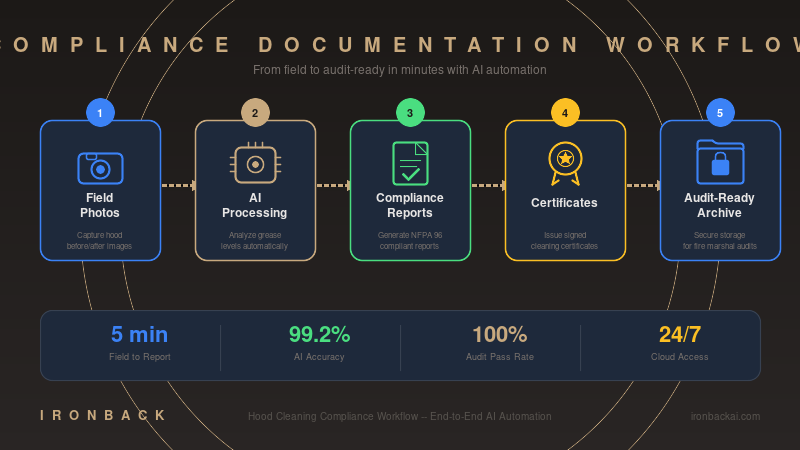
Artificial intelligence is transforming compliance documentation workflows for hood cleaning contractors by automating data capture and improving accuracy. AI systems can process handwritten notes and field photos, extract key details about exhaust systems and grease buildup, and generate standardized reports and cleaning certificates that are consistent and audit-ready.
According to Grand View Research (2024), the global AI in regulatory affairs market is expected to reach USD 6.65 billion by 2033, reflecting the growing shift toward AI-driven compliance and documentation solutions across industries including fire protection.
Current Workflow vs AI-Powered Compliance Documentation Workflow
The difference between manual and AI-powered hood cleaning compliance workflows is significant. A traditional workflow relies on manual steps at every stage, while an AI-powered digital workflow simplifies and automates the entire process from field capture to final certificate.
Traditional workflows use manual handwriting on paper forms. AI-powered workflows use automated extraction from photos and voice input.
Manual processes leave photos unorganized with manual labeling. AI auto-structures images with timestamps and GPS data.
Manual reports take hours or days after job completion. AI generates compliance reports instantly in real time.
Manual workflows carry high error risk from illegible writing and missing data. AI validation and standardized fields reduce errors significantly.
Physical folders or scattered PDFs versus a centralized, searchable cloud database with full audit trail.
The improvements are measurable. Documentation time is reduced, data accuracy improves, and compliance reports are ready to send much faster than manual alternatives.
Core Features of Hood Cleaning Compliance Documentation AI
AI provides key features that support accurate and complete compliance documentation for hood cleaning contractors.
AI Document Processing for Hood Cleaning Compliance
The system reads forms and extracts data automatically, including recognizing handwritten input, structuring data into clean formats, and validating required fields. This supports NFPA 96 documentation automation and eliminates the need for manual data re-entry at the office.
Automated NFPA 96 Compliance Reports
Reports are generated in a standardized format that includes inspection checklists, highlights non-compliant areas, and organizes information clearly. Each report follows NFPA 96 requirements and is ready for fire marshal review without additional formatting.
AI Photo Documentation for Compliance Proof
Photos are critical for compliance. The system stores before and after images with timestamps and location data, serving as NFPA compliance photo proof. This creates a verifiable visual record of every cleaning job.
Automated Compliance Certificate Generation
Certificates are created automatically after job completion. They are consistent in format, ready to send to property managers and fire marshals, and easy to store and track in a centralized system.
AI for Grease Buildup Tracking and Cleaning Verification
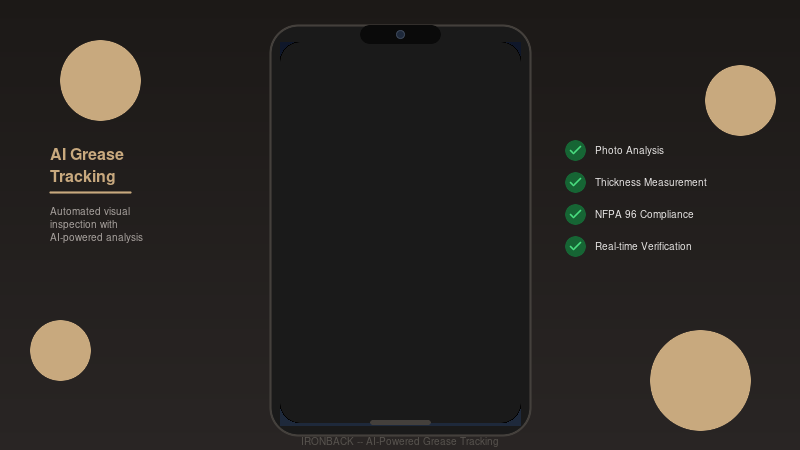
AI also helps monitor system conditions over time. Grease buildup tracking uses AI to compare before and after conditions, enabling better planning for future cleaning intervals. Cleaning scope verification identifies missed sections and maintains consistent cleaning quality across jobs. If deficiencies are found in hood systems, they are recorded automatically with supporting data, including system damage and potential compliance violations.
Fire Marshal and NFPA Compliance with AI Documentation
AI improves how documentation is prepared for fire marshal inspections. Documents are clear, complete, and easy to review, which helps speed up the inspection process. The system stores compliance certificates, inspection history, and service records in one accessible location. Fire code violations are recorded automatically with supporting data, which helps with audits and follow-ups.
Insurance and Liability Benefits of Compliance Documentation AI
Proper documentation reduces risk for hood cleaning contractors. Clear documentation helps prove work was completed and avoids disagreements during re-inspection disputes. Documents follow a consistent, standardized compliance documentation format that is easy to send, easy to review, and ready for insurance use. All activity is recorded with work history, timestamps, and supporting documentation to create complete audit trails for legal protection.
AI-Powered Tracking for Hood Cleaning Operations
AI supports daily operations beyond documentation. Service interval tracking schedules future cleaning automatically, and reminders help maintain compliance. Hood system inventory tracking creates complete records for each system, helping track maintenance history and condition. Chemical and cleaning logs are documented clearly to support compliance documentation and reporting requirements.
Mobile Documentation for Hood Cleaning Contractors
Mobile tools simplify field work for hood cleaning technicians. From one device, technicians can capture photos, enter data, and submit reports. Compliance reports are generated in real time immediately after the job, with no extra steps needed. Digital signatures allow clients to approve work on-site, and documents are finalized instantly.
Business Impact of Hood Cleaning Compliance Documentation AI
AI improves both operations and business performance for hood cleaning contractors. Workflows become faster and easier to manage. Errors are reduced and data stays consistent across all documentation. Complete reports allow faster billing and payments, shortening the invoice cycle and improving cash flow.
How to Implement Hood Cleaning Contractor Compliance Documentation AI
Implementation can be done step by step. You need mobile devices, an AI documentation system, and workflow integration with existing business tools. Teams need to learn how to capture proper photos and how to use the system effectively. The system connects with CRM and invoicing tools to create a seamless workflow from field to office.
Future of Hood Cleaning Compliance Documentation AI
AI will continue to improve hood cleaning contractor compliance documentation by making processes more accurate, efficient, and data-driven. Predictive maintenance helps determine when cleaning is needed based on usage patterns and grease buildup, allowing contractors to plan services more effectively. Compliance dashboards and analytics provide real-time visibility into documentation status, inspections, and service history. Over time, historical data improves reporting accuracy, optimizes workflows, and supports better decision-making for fire safety compliance.
Hood Cleaning Contractor Compliance Documentation AI with Ironback.ai
Ironback.ai focuses on making compliance documentation simple and reliable for hood cleaning contractors. The approach uses AI to convert photos into documents, structure data automatically, and prepare reports for audits. The AI-5 system delivers automated data extraction, compliance certificate generation, and ready-to-use documentation packages.
Getting started begins with reviewing the current workflow and identifying areas that can be improved. Hood cleaning contractor compliance documentation AI simplifies documentation and improves compliance accuracy. The process becomes faster, the data becomes cleaner, and inspections become easier to handle.
Frequently Asked Questions
What is hood cleaning contractor compliance documentation AI?
Hood cleaning contractor compliance documentation AI is a system that uses artificial intelligence to automate the creation, management, and storage of compliance records for hood cleaning services. This includes generating NFPA 96 reports, cleaning certificates, inspection records, and photo documentation packages without manual data entry or paperwork.
How does AI improve hood cleaning compliance documentation?
AI improves compliance documentation by automatically extracting data from field forms and photos, reducing manual entry, and minimizing transcription errors. It generates accurate, standardized NFPA 96 reports and cleaning certificates in real time, cutting documentation time from hours or days to minutes after job completion.
Is hood cleaning compliance documentation AI required for NFPA 96 compliance?
AI is not required for NFPA 96 compliance, but it significantly helps contractors meet documentation standards more consistently. By automating report generation, photo documentation, and inspection records, AI ensures proof of cleaning is complete, accurate, and properly formatted for fire marshal review every time.
What documents can hood cleaning contractor compliance documentation AI generate?
AI systems generate compliance reports, cleaning certificates, inspection records with checklists, timestamped photo documentation packages, chemical and cleaning logs, and service history records. All documents are formatted to meet NFPA 96 standards and are ready for fire marshal review, insurance audits, and regulatory compliance checks.
Can AI documentation help with fire marshal inspections and insurance claims?
Yes. AI-generated documentation provides clear, structured, and verifiable records with timestamps, GPS data, and before-after photos that support fire marshal inspections. These records also strengthen insurance claims by proving work was completed properly, reducing re-inspection disputes and providing complete audit trails for legal protection.
Related
Find your first automation
Use the free Operations Scorecard. Two questions give you one workflow to investigate and a measure to check before building.