Ansul Contractor 6 Month Renewal Automation: The System That Keeps You Fully Booked Without Chasing Clients
Ansul contractor 6 month renewal automation keeps inspection schedules full by building a simple system that runs in the background. It tracks compliance dates, sends reminders at the right time, and makes booking easy. This removes the need to chase clients manually and protects repeat revenue that would otherwise slip through the cracks.
If contractors want consistent bookings and fewer gaps in the schedule, they need a system that works every day without extra effort. This guide covers the exact steps to build an Ansul renewal automation system, from CRM tagging and the 4-touch reminder sequence to automated scheduling and NFPA 96 compliance documentation.
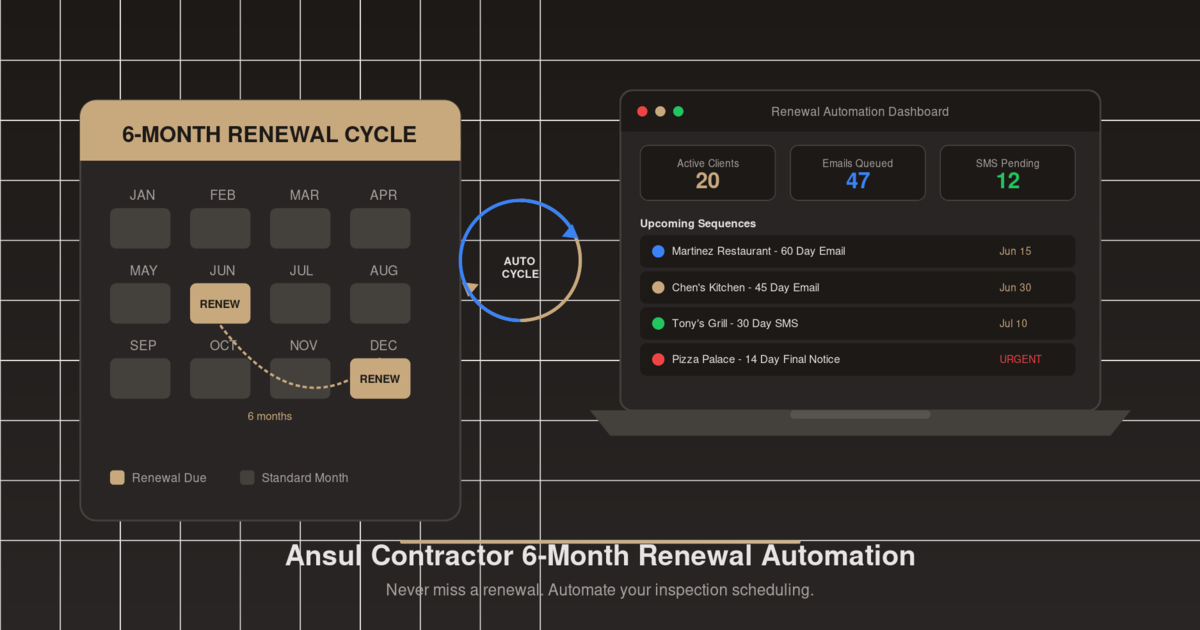
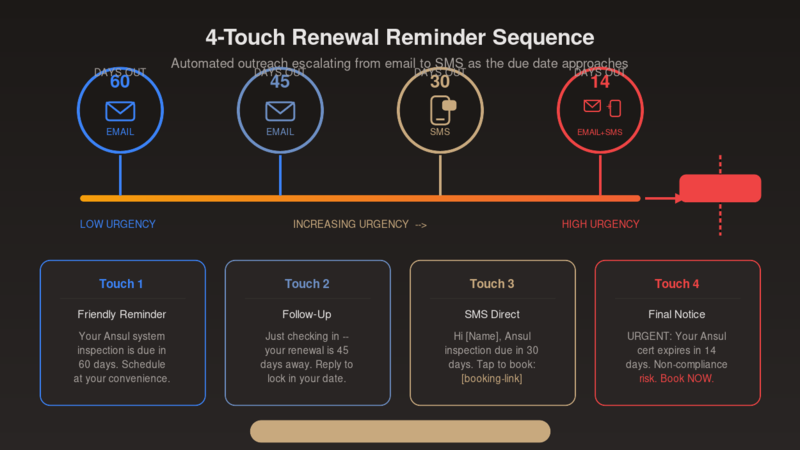
Ansul contractor 6 month renewal automation works because it replaces manual follow-up with a simple, repeatable process that runs on schedule every time. Reminders go out at 60, 45, 30, and 14 days before the due date. Clients are tagged based on compliance dates inside a CRM. Booking is simplified with direct scheduling links that eliminate back-and-forth communication.
Ansul contractor 6 month renewal automation is a CRM-driven system that tracks every client inspection date, triggers a 4-touch reminder sequence at 60, 45, 30, and 14 days before each due date, and connects automated scheduling links so clients book without phone calls or emails. The system uses compliance date tagging, smart segmentation of active and overdue accounts, and multi-channel outreach through email and SMS. For a contractor with 20 active Ansul clients at $3,500 per service and two inspections per year, this automation protects $140,000 in annual repeat revenue while maintaining NFPA 96 semi-annual inspection compliance. Ironback.ai deploys this as a fully managed renewal engine inside fire suppression and hood cleaning contractor operations.
Why Ansul Contractors Lose Revenue Without a 6-Month Renewal System
Most revenue loss for Ansul contractors does not come from bad service. It comes from missed follow-ups and poor tracking. Many contractors still rely on memory, notes, or spreadsheets to track inspection dates. This approach works at a small scale, but it breaks quickly as the client list grows. Dates get missed or entered incorrectly, no one checks the list daily, follow-ups happen too late, and there is no clear system for reminders. Over time, this creates gaps in the schedule that are hard to recover from.
How Missed Ansul Renewals Impact Revenue
Every missed renewal is lost repeat business. Since Ansul inspections happen every six months, each client should generate two jobs per year. One missed cycle cuts annual revenue from that client in half. Several missed clients create empty weeks in the calendar. New client acquisition becomes necessary to fill gaps that should have been repeat bookings. Retention is always more predictable and cost-effective than new sales.
Compliance Risk Under NFPA 96 for Ansul Systems
Clients rely on Ansul contractors to help them stay compliant with NFPA 96 semi-annual inspection requirements. When contractors fail to send timely reminders, they increase client risk. Inspections must happen every six months, fire marshals frequently check compliance records, and delays can create serious liability for both the client and the contractor.
Fire suppression systems in commercial kitchens require consistent maintenance to reduce fire risk and ensure safe operation. According to the National Fire Protection Association, cooking equipment is involved in 48 percent of reported home structure fires, reinforcing the need for reliable maintenance systems that keep Ansul inspections on track and commercial kitchen fire suppression systems properly maintained.
What Ansul Contractor 6 Month Renewal Automation Actually Means
Renewal automation means tracking Ansul inspection dates and triggering reminders automatically based on those dates. There is no manual checking required, no guessing when to follow up, and no missed opportunities. The system handles timing so contractors can focus on delivering service. As noted in the NFPA 96 standard, systems serving moderate-volume cooking operations must be inspected semi-annually, a requirement that automation ensures is never overlooked.
To make Ansul contractor 6 month renewal automation work, a few basic components must operate together. A CRM stores client data and inspection history. Tags based on renewal dates trigger automated workflows. Email and SMS sequences deliver reminders at the right intervals. A scheduling system allows clients to book directly without back-and-forth communication. Each part supports the others to create a self-running renewal engine.
The goal of this automation is straightforward. Contractors want a full schedule without constant manual effort. The system keeps clients on a regular 6-month cycle, reduces administrative time, increases repeat jobs, and eliminates last-minute scheduling scrambles. When the system runs well, work becomes predictable and revenue becomes stable.
The 4-Touch Ansul Renewal Sequence That Drives Consistent Bookings
The 4-touch renewal sequence ensures Ansul contractors reach clients at the right time without being pushy. Each touchpoint has a clear role, channel, and message so nothing feels random or repetitive. This structured approach converts passive clients into confirmed bookings before their compliance deadline arrives.
The first reminder sets the tone for the entire sequence. It informs the client their Ansul inspection is coming up, includes the exact due date, and provides a direct scheduling link. The goal is calm, clear awareness without pressure.
This message introduces light urgency by encouraging early booking to secure preferred time slots. It explains that schedules tend to fill up closer to the due date and provides a few available scheduling options to guide the client toward action.
At this point, the channel switches to SMS for faster, more direct communication. The message is kept short with 2 to 3 immediate booking options and a scheduling link. This touchpoint often drives the highest conversion because the message is simple and convenient.
The final touchpoint uses both email and SMS to maximize visibility. It highlights the risk of becoming overdue on NFPA 96 compliance and makes the next step obvious with a clear booking link. This ensures nearly every client is reached before their compliance deadline passes.
How to Tag and Segment Clients for Ansul Renewal Automation
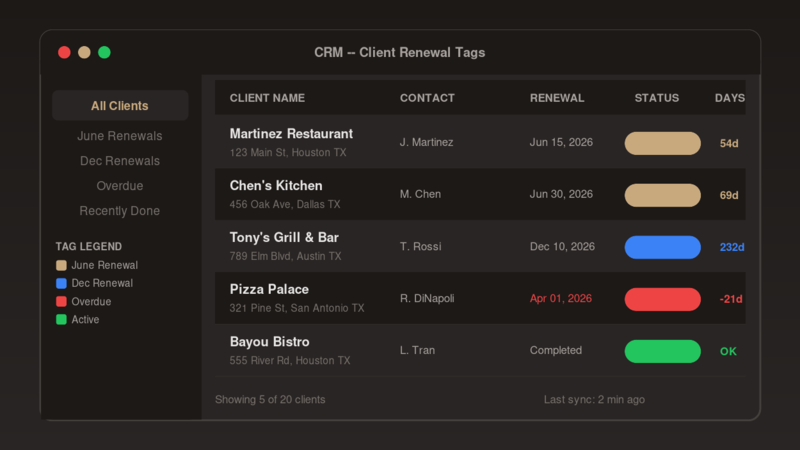
Without proper tagging, Ansul contractor 6 month renewal automation does not work correctly. Contractors assign tags based on when each client is due, such as June Renewal or December Renewal. This allows workflows to trigger based on time without manual intervention. Not all clients are in the same stage. Active clients follow the normal 6-month cycle, inactive clients missed a renewal, and overdue clients need immediate attention. Each group receives different messages tailored to their situation.
Smart lists inside the CRM update automatically based on rules. A 60-day list, 45-day list, 30-day list, and 14-day list each feed into the corresponding touchpoint in the 4-touch sequence. This removes the need to check dates manually and ensures every Ansul client enters the reminder workflow at exactly the right time.
Automating Ansul Inspection Scheduling Without Back-and-Forth
Scheduling is often where the most time gets wasted in Ansul renewal workflows. Instead of multiple emails and phone calls, the automation system sends one scheduling link. Clients pick their own time, there are no delays in communication, and booking decisions happen faster. The system syncs with technician calendars so availability is always current, double bookings are avoided, and schedule changes are reflected instantly.
Automation also helps reduce no-shows and delays by sending appointment reminders before each visit, confirming bookings automatically, and keeping communication clear throughout the process. Prepared clients lead to faster, more efficient inspections on site.
Automating Ansul Compliance Documentation and Reporting
Paperwork often slows everything down after the Ansul inspection is complete. With automation, digital inspection reports are generated right after the job. There is no need to rewrite notes later because the data is already structured and reports are consistent. Compliance certificates are sent to clients automatically with no waiting for manual processing, and clients have easy access to documentation for audits and fire marshal inspections.
All maintenance logs and records stay in one centralized location. They are easy to search when needed, helpful during NFPA 96 compliance reviews, and never lost or misplaced. Good records build trust with clients and demonstrate professionalism that supports long-term retention.
Revenue Math Behind Ansul 6-Month Renewal Automation
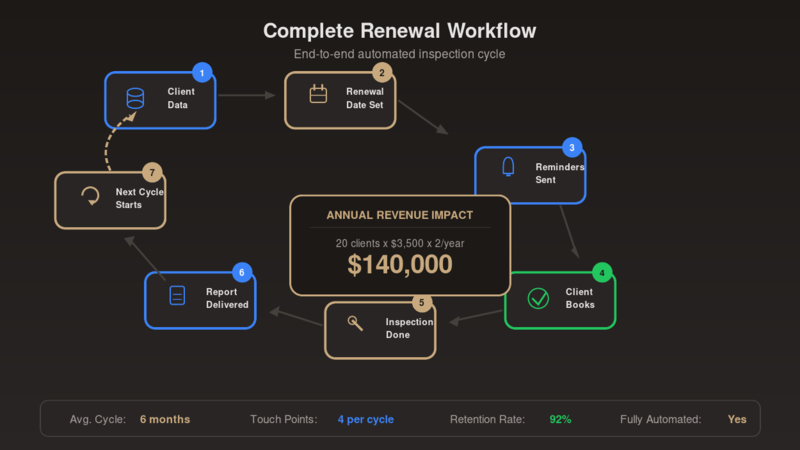
Ansul contractor 6 month renewal automation directly protects revenue that would otherwise leak through missed follow-ups. The math is straightforward. With 20 active Ansul clients at $3,500 per service and two services per year, total annual repeat revenue reaches $140,000. This comes from existing relationships alone, with no new client acquisition required.
At $3,500 per Ansul inspection and two inspections per year per client, 20 clients generate $140,000 in predictable annual repeat revenue through the automated renewal cycle.
Without a renewal system, some clients forget to book, others switch to a different contractor, and gaps appear in the schedule. Even losing a few clients per cycle creates significant revenue loss.
Timely reminders increase bookings, clients stay on their 6-month schedule, and revenue becomes predictable. The system pays for itself by preventing even one missed renewal per quarter.
Common Mistakes Ansul Contractors Make with Renewal Tracking
The most common mistake is relying on memory or manual lists. Manual systems fail under pressure because it is easy to forget dates, hard to scale as the client base grows, and there are no automatic triggers to initiate follow-up. This leads to missed opportunities and inconsistent scheduling that compounds over time.
Sending reminders too late is another critical error. Timing matters more than message quality in Ansul renewal outreach. Late reminders reduce scheduling options, clients may already book with another contractor, and available time slots fill up quickly. Early contact at 60 days gives clients the most flexibility and gives contractors the highest conversion rate.
Having no clear follow-up system is the third major mistake. One message is never enough. Clients get busy, emails are ignored, and without a structured sequence there is no consistency. The 4-touch approach solves this by creating multiple opportunities for the client to take action across different channels.
Building Your Ansul Contractor Automation Workflow Step by Step
Setting up Ansul contractor 6 month renewal automation follows a clear five-step process. Step one is collecting and organizing client data including business name, contact details, and last inspection date. Everything depends on having accurate starting data. Step two is setting renewal dates by adding six months to the last Ansul inspection, storing the date in the CRM, and using it as the trigger point for all automated workflows.
Step three is creating the 4-touch sequence with emails at 60 and 45 days, SMS at 30 days, and a final email plus SMS follow-up at 14 days. Step four connects scheduling and CRM by adding scheduling links to every message, syncing with technician calendars, and tracking all bookings automatically. Step five is monitoring and improving performance over time by checking open rates, tracking booking conversion rates, and adjusting messaging based on results. Small improvements to subject lines and timing can significantly increase conversions.
How Ansul Renewal Automation Supports Long-Term Client Retention
Retention is where real business stability comes from for Ansul contractors. When clients experience a predictable service cycle, they come to expect reminders, book earlier, and stay consistent with their 6-month compliance schedule. Reliable automated systems build confidence because messages arrive on time, service is predictable, and communication is clear. Trust leads to repeat business that compounds year over year.
Every Ansul client becomes part of a self-sustaining renewal cycle. There is no need to resell the service each time. Less effort generates more revenue, and stronger relationships develop naturally through consistent, professional communication. This long-term retention advantage is what separates contractors who grow steadily from those who constantly chase new clients to replace the ones they lost.
Ansul Contractor 6 Month Renewal Automation in Practice
A fully automated Ansul renewal workflow follows a simple, repeatable cycle. Client data is stored in the CRM, the renewal date is set based on the last inspection, reminders are sent automatically through the 4-touch sequence, the client books through a scheduling link, the inspection is completed, and the report and compliance certificate are delivered. No step requires manual tracking or follow-up. The entire process runs itself.
Implementation can happen within a single week. Import client data into the CRM, add compliance date tags, build the 4-touch workflow, and connect scheduling tools. Once the system is active, the difference is immediate. No more chasing clients, fewer gaps in the schedule, better time management, and more predictable revenue from every 6-month Ansul renewal cycle.
Ansul Contractor 6 Month Renewal Automation: Building a System That Runs Itself
This system is not about adding more work. It is about making sure every Ansul inspection and 6-month renewal happens on time without extra effort. When contractors use automation correctly, they stop relying on memory and manual follow-ups. Instead, they build a system that tracks every Ansul compliance date, sends reminders automatically, and keeps every client on schedule.
At Ironback.ai, the focus is on building systems that turn complex Ansul renewal workflows into simple, repeatable processes. This allows contractors to manage renewals, scheduling, and NFPA 96 compliance without constant manual input. For contractors who want to keep inspection schedules full, protect repeat revenue from every 6-month cycle, and reduce daily operational stress, this is the starting point. The renewal system can be set up within one week and begins producing results immediately.
Frequently Asked Questions
What is Ansul contractor 6 month renewal automation?
Ansul contractor 6 month renewal automation is a CRM-based system that tracks every client inspection date, sends timed reminders at 60, 45, 30, and 14 days before each due date, and automates scheduling so clients stay on their NFPA 96 semi-annual compliance cycle without manual follow-up.
How does the 4-touch renewal sequence work for Ansul contractors?
The 4-touch sequence sends an awareness email at 60 days, an early booking email at 45 days, a direct SMS at 30 days, and a final compliance risk reminder via email and SMS at 14 days before the Ansul inspection due date.
How much revenue does Ansul renewal automation protect?
With 20 active Ansul clients at $3,500 per inspection and two services per year, renewal automation protects $140,000 in annual repeat revenue. It prevents missed follow-ups, eliminates scheduling gaps, and keeps every client on their mandatory NFPA 96 semi-annual compliance cycle without manual intervention.
What CRM tagging is needed for Ansul renewal automation?
Clients are tagged by compliance date such as June Renewal or December Renewal, then segmented into active, inactive, and overdue categories. Smart lists inside the CRM update automatically and trigger the correct reminder at each interval in the 4-touch email and SMS sequence.
How quickly can Ansul contractor renewal automation be set up?
The full Ansul renewal automation system can be implemented within one week. The process involves importing client data into a CRM, setting compliance date tags for each account, building the 4-touch reminder workflow with email and SMS, and connecting scheduling tools for direct client booking.
Related
Find your first automation
Use the free Operations Scorecard. Two questions give you one workflow to investigate and a measure to check before building.