AI Estimating for Compressed Air Service Companies: Quote Atlas Copco and Kaeser Repairs the Same Day
AI Estimating Software Is Changing How Compressed Air Repair Companies Quote Jobs
Compressed air repair AI estimating software uses machine learning to automate cost calculations for service companies working on Atlas Copco, Kaeser, Ingersoll Rand, and other major brands. Instead of spending hours manually referencing parts catalogs and labor tables, technicians and estimators can upload photos, fault codes, and service history to generate accurate repair quotes in seconds. The result is a faster sales cycle, fewer pricing errors, and more jobs won per week.
For compressed air service businesses, quoting speed is a competitive advantage. Facility managers requesting emergency compressor repairs do not wait days for a proposal. AI estimating tools bridge the gap between field diagnostics and office-based quoting by pulling real-time pricing data, historical repair costs, and equipment specifications into a single automated workflow.
Key Performance Metrics for AI Estimating in Compressed Air Service
AI-generated estimates reduce the average quoting cycle from hours to minutes for standard compressed air repairs.
AI handles routine quotes autonomously, but multi-system failures and custom fabrication still require experienced technician review.
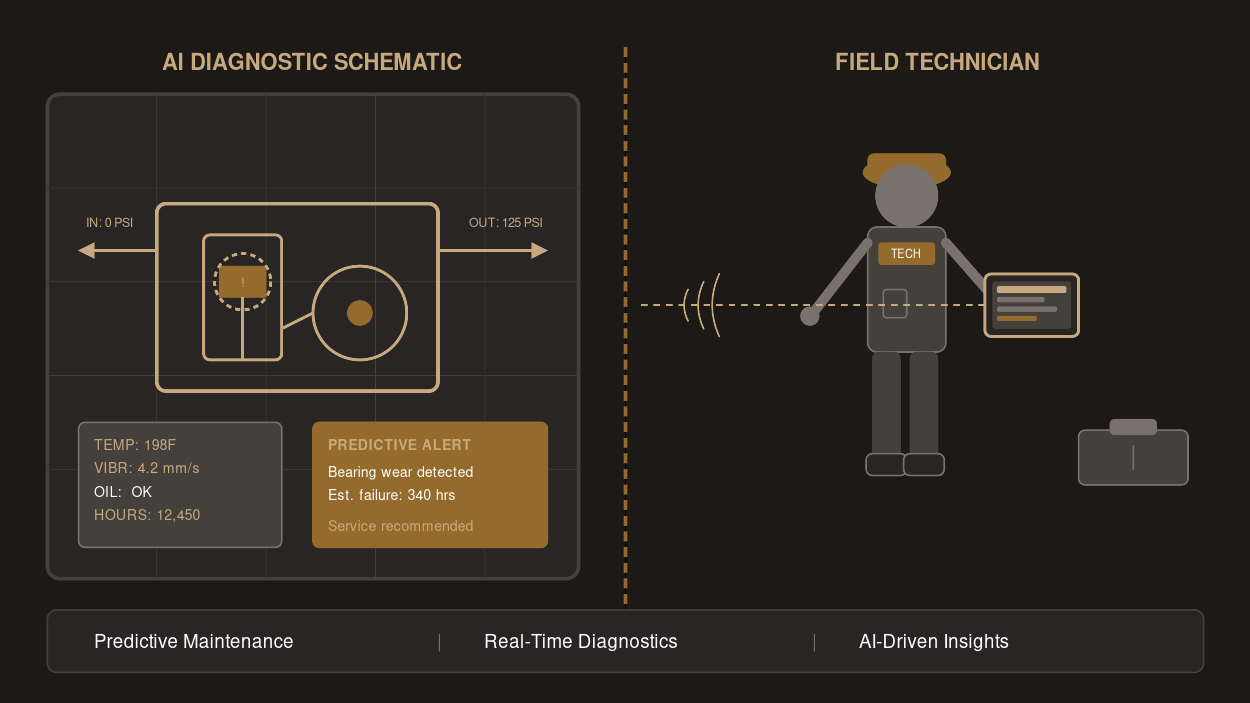
AI estimating platforms can monitor compressor vibration, temperature, and pressure data to flag repairs before failures occur.
How AI Estimating Software Works for HVAC and Compressed Air Contractors
AI estimating software follows a structured pipeline to convert raw job data into a deliverable quote. The process starts when a technician or sales rep uploads files such as compressor schematics, equipment photos, or manufacturer fault codes. The AI engine performs a digital takeoff, detecting components like rotary screw assemblies, air-end housings, dryer units, and filtration systems from the uploaded documentation.
Once components are identified, the software applies current pricing from parts databases, calculates labor hours based on historical job data, and factors in travel time and equipment rental costs. Predictive analytics layered on top can flag components that are nearing end-of-life based on runtime hours, allowing the estimator to recommend preventive replacements in the same quote. The final output is a professional proposal ready to send to the customer, saving up to 90% of the time traditionally spent on manual estimating.
Key Features of AI Estimating Platforms for Compressed Air Service
The most effective AI estimating platforms for compressed air repair share several core capabilities. AI-powered takeoffs automatically extract component lists from uploaded drawings and photos, eliminating manual counting. Predictive maintenance modules connect to compressor control systems and SCADA data to monitor real-time operating conditions across Atlas Copco GA series, Kaeser SX/SM units, and other common models.
Automated bill of quantities generation produces itemized parts and labor breakdowns that can be exported to accounting and ERP systems. Real-time dashboards give service managers visibility into open quotes, conversion rates, and average job margins. Mobile and cloud access ensures that field technicians can initiate quotes from job sites without returning to the office, keeping the sales pipeline moving even during heavy service periods.
Benefits and Limitations of AI Estimating for Compressed Air Repair
Routine compressor repair quotes that previously took 2-4 hours can be generated in under 15 minutes with AI assistance.
AI cross-references live parts pricing and historical labor data to reduce the manual errors common in spreadsheet-based estimating.
AI estimating tools still produce errors in 8-12% of quotes, particularly on non-standard configurations and legacy equipment.
Connecting AI estimating to existing field service management, accounting, and dispatch systems requires configuration and data mapping.
The benefits of AI estimating are clear for high-volume compressed air service operations. Faster quoting means more proposals sent per day, which directly increases win rates. Predictive maintenance capabilities allow service companies to shift from reactive break-fix work to proactive contract-based service, stabilizing revenue. However, limitations remain. Complex multi-system drawings and legacy equipment without digital documentation can confuse AI models. Manual verification by an experienced estimator is still essential for quotes involving custom fabrication, obsolete parts sourcing, or multi-vendor system integrations.
How AI Improves Cost Accuracy in Compressed Air Maintenance
AI estimating software improves cost accuracy by combining three data layers that manual estimators rarely access simultaneously. First, real-time sensor data from connected compressors provides actual operating conditions including discharge pressure, oil temperature, and motor amperage. Second, historical service records reveal patterns in component failure rates and labor requirements for specific equipment models. Third, predictive analytics algorithms process these inputs to forecast which parts will fail within a defined time window.
Research published in MDPI journals indicates that AI-driven predictive maintenance strategies can reduce overall maintenance costs by up to 80% compared to purely reactive approaches. For compressed air service companies, this means more accurate quotes that account for the true scope of work, fewer costly return visits for missed issues, and better margin control across the service portfolio.
AI estimating software for compressed air repair combines real-time sensor data, historical service records, and predictive analytics to generate quotes 30-50% faster than manual methods while reducing maintenance costs by up to 80%. The most effective implementations use a hybrid approach where AI handles routine calculations and component identification, and experienced technicians validate complex repairs involving Atlas Copco, Kaeser, and multi-vendor systems.
The Role of Human Oversight in AI-Assisted Estimating
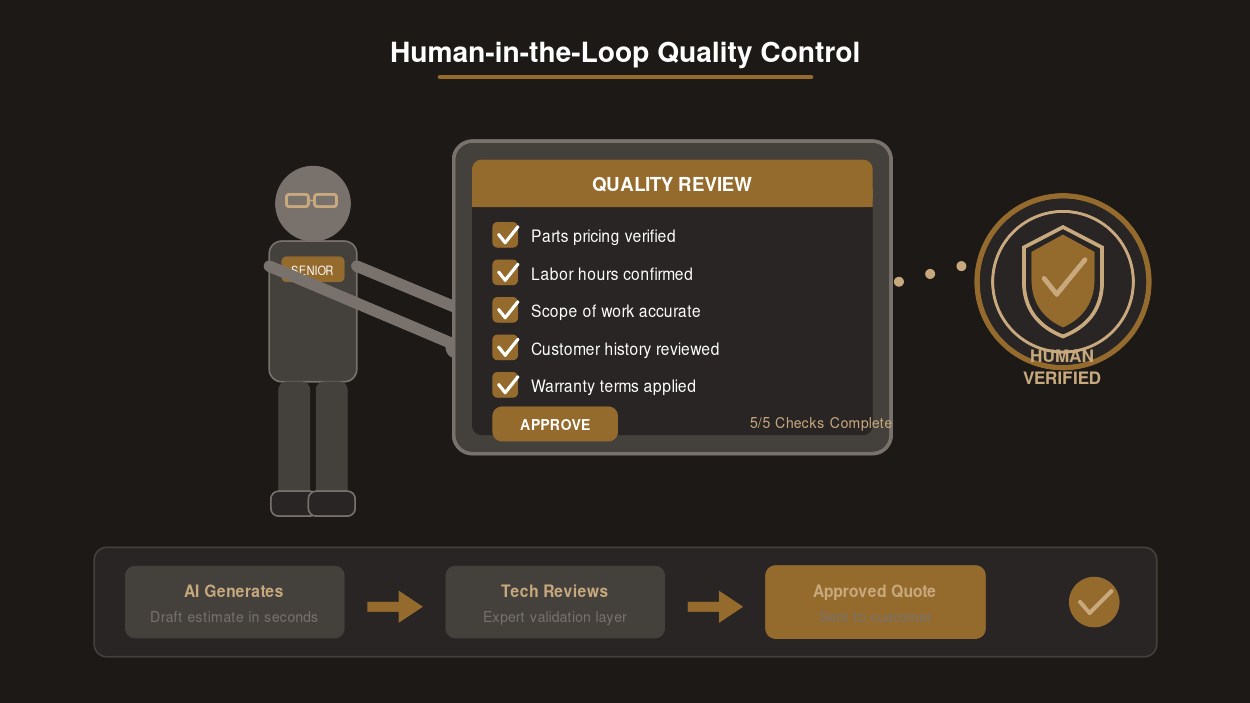
Despite significant advances in machine learning, AI estimating tools can miss up to 20% of fixtures and components on complex compressed air system drawings. This gap is most pronounced in retrofitted facilities where original equipment has been modified, piping layouts have changed, or aftermarket components from non-OEM suppliers are installed. A hybrid approach where AI generates the initial estimate and a human estimator reviews and adjusts the output consistently delivers the best results.
Human oversight serves three critical functions in the AI estimating workflow. Estimators catch components the AI missed or misidentified, apply contextual knowledge about site conditions that are not captured in documentation, and make judgment calls on repair-versus-replace decisions that require experience with specific equipment brands. The goal is not to replace the estimator but to eliminate the repetitive data entry and math that consumes most of their time.
Integration with Field Service Operations
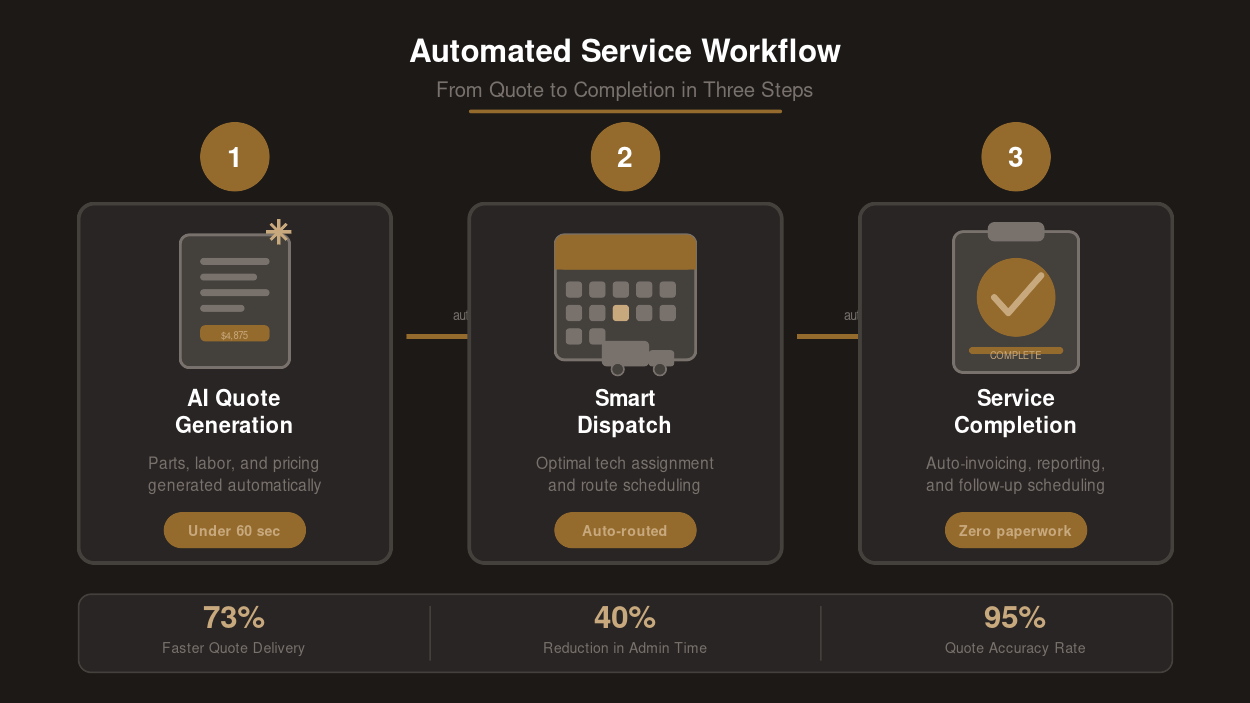
AI estimating delivers the most value when it connects directly to field service management workflows. Once a quote is approved, the system can automatically generate parts purchase orders, assign the job to the nearest qualified technician, and schedule the repair window based on customer priority and technician availability. This closed-loop system eliminates the handoff delays that occur when quoting, dispatch, and parts ordering operate in separate tools.
Automated parts lists generated from the AI estimate feed directly into supplier ordering systems, reducing the risk of technicians arriving on site without the correct components. Smart job assignment algorithms match repair complexity to technician certifications and experience levels, ensuring that Atlas Copco VSD compressor repairs go to technicians trained on variable speed drive systems. The result is fewer return visits, faster job completion, and higher first-time fix rates.
Training AI Estimating Software for Your Compressed Air Business
Off-the-shelf AI estimating tools provide a baseline, but custom training is what transforms them into a competitive advantage. By feeding the AI your historical job data including past quotes, actual vs. estimated costs, labor hours by repair type, and preferred vendor pricing, the system learns your specific business patterns. Most platforms show measurable accuracy improvements within 90 days of custom training.
The training process works best when compressed air service companies provide structured data from at least 100-200 completed jobs. The AI learns which parts fail most frequently on specific compressor models, how long repairs actually take versus original estimates, and which pricing adjustments lead to higher close rates. Over time, the system becomes a digital version of your most experienced estimator, applying institutional knowledge at scale across every quote.
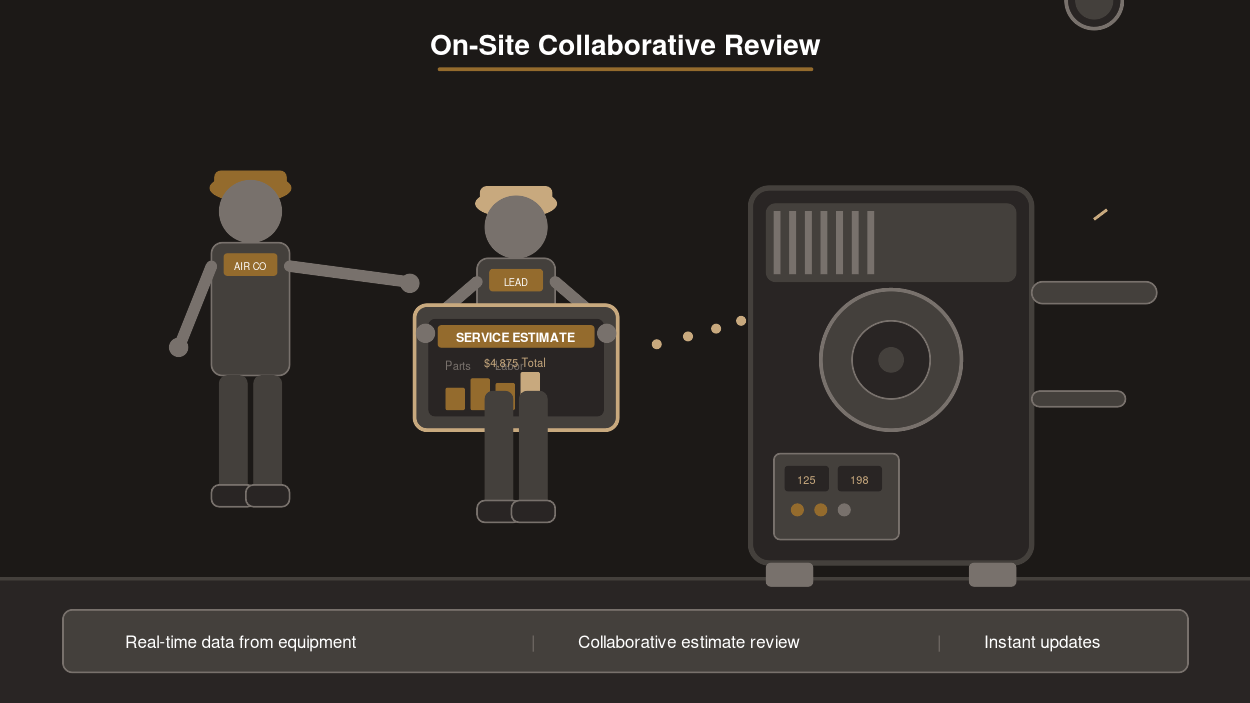
Predictive Maintenance as a Revenue-Generating Service Offering
AI estimating platforms that include predictive maintenance capabilities open a new revenue channel for compressed air service companies. Instead of waiting for equipment failures, service businesses can offer ongoing monitoring contracts that track compressor health metrics and automatically generate maintenance quotes when performance thresholds are crossed. This shifts the business model from unpredictable emergency repair revenue to stable, recurring contract income.
Regular health reports generated by the AI system provide tangible value to facility managers by documenting compressor efficiency trends, flagging energy waste from air leaks, and recommending maintenance actions with cost-benefit analysis. For the service company, each monitoring contract creates a pipeline of predictable repair and parts replacement work. Customers see fewer unplanned shutdowns. The service company sees steadier cash flow and stronger customer retention across their Atlas Copco, Kaeser, and multi-brand accounts.
Frequently Asked Questions
How does AI estimating software improve compressed air repair quotes?
AI estimating software analyzes uploaded compressor schematics, fault codes, and service history using machine learning to automatically identify components, calculate labor hours, and apply real-time parts pricing. This process reduces quoting time by up to 90% compared to manual spreadsheet-based estimating, while cross-referencing historical job data to improve cost accuracy on Atlas Copco, Kaeser, and Ingersoll Rand equipment repairs.
Can AI-powered estimating handle complex HVAC and compressed air systems?
AI estimating handles routine compressed air repairs with high accuracy but still requires human validation for complex multi-system configurations, retrofitted facilities, and legacy equipment without digital documentation. Current AI tools miss up to 20% of components on complex drawings, making a hybrid approach where AI generates the initial estimate and an experienced technician reviews it the most reliable method for HVAC and compressed air service companies.
What features should I look for in AI construction estimating software?
Essential features for compressed air service companies include AI-powered digital takeoffs, automated bill of quantities generation, predictive maintenance integration, real-time parts pricing databases, and mobile cloud access for field technicians. The platform should also integrate with your existing field service management and accounting systems to create a closed-loop workflow from quote approval through dispatch, parts ordering, and invoicing.
How does predictive maintenance work with compressed air systems?
Predictive maintenance for compressed air systems uses sensors to continuously monitor compressor vibration, temperature, pressure, and motor amperage data. AI algorithms analyze these readings against historical failure patterns to predict component failures before they occur, automatically generating maintenance quotes and scheduling service visits. Research indicates this approach can reduce overall maintenance costs by up to 80% compared to reactive break-fix strategies.
Can AI estimating software improve profitability for service businesses?
AI estimating software improves profitability by increasing quote volume, reducing estimating labor costs, and enabling predictive maintenance contracts that generate recurring revenue. Service companies using AI estimating typically send more proposals per day with fewer pricing errors, leading to higher win rates and better margin control. The addition of predictive maintenance monitoring creates a stable revenue stream from ongoing contracts rather than relying solely on unpredictable emergency repair calls.
Related
Find your first automation
Use the free Automation Opportunity Finder. Four questions give you one workflow recommendation and the measures that should prove it works.